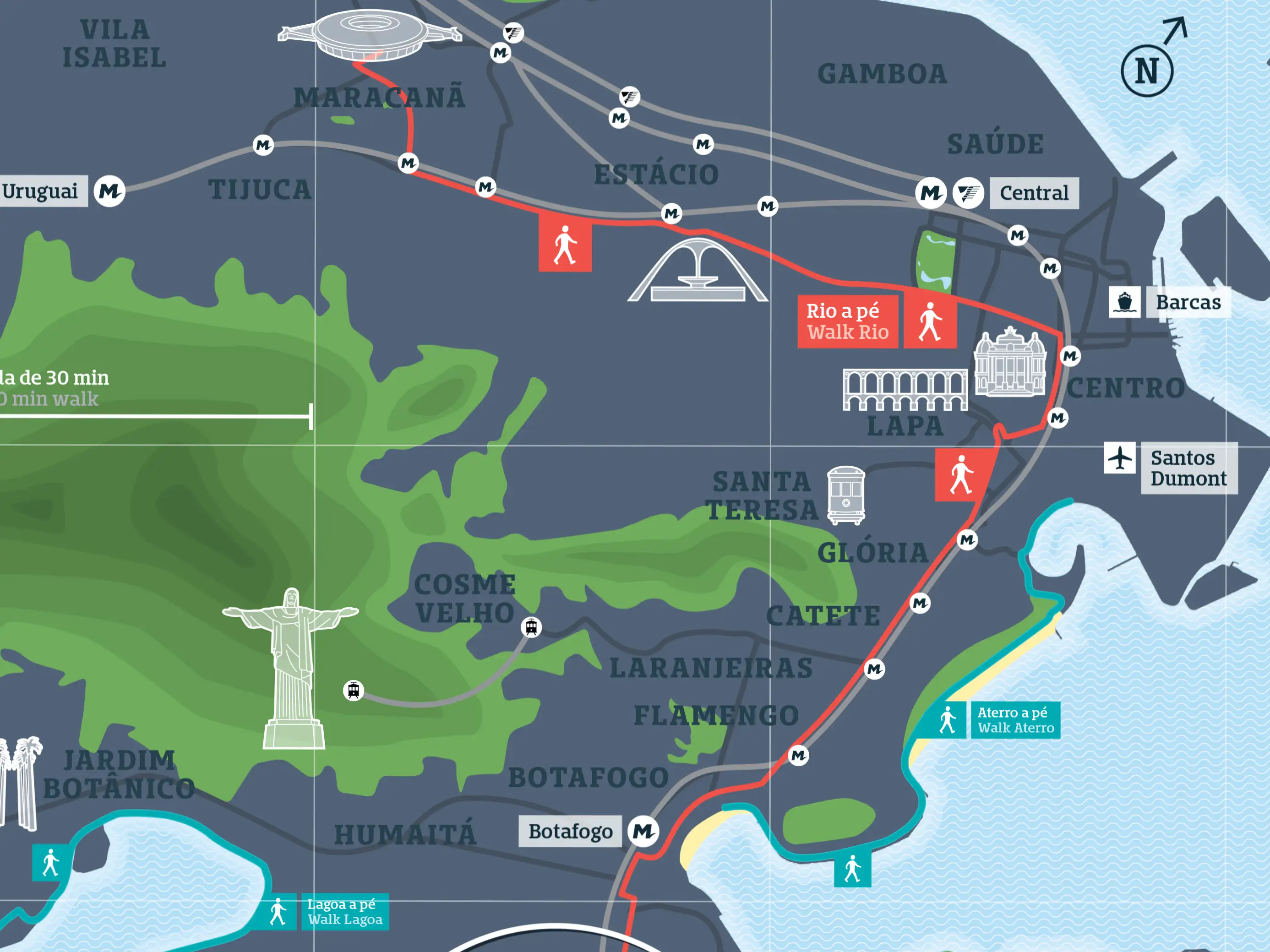
Choosing where to stay in Rio de Janeiro is not as simple as picking the neighborhood with the best reputation. Your address affects the price of the trip, how much time you spend in traffic, whether you can walk to dinner, and how comfortable the final part of the journey feels after dark.
For a first visit, the most useful question is not “What is the safest neighborhood in Rio?” but “Is this particular hotel or apartment close to the places I need, on an active street, and near reliable transport?” No part of Rio is risk-free, and conditions can change from one street to the next.
This guide compares Copacabana, Leme, Ipanema, Leblon, Botafogo, Flamengo, Catete, Laranjeiras, and Barra da Tijuca. It is designed for visitors who want a practical base for beaches, sightseeing, restaurants, and getting around the city.
Interactive map of Rio neighborhoods
Use the markers and neighborhood cards to compare locations, landmarks, and the character of each area.
The short answer: the best Rio neighborhoods for visitors
Copacabana is the most versatile first-trip base. It has a huge range of hotels and apartments, an ocean beach, three metro stations, restaurants at almost every price point, and straightforward connections to Rio’s major sights.
Ipanema suits travelers who want a more compact neighborhood, a popular beach, a strong restaurant scene, and a calmer evening atmosphere—and who are comfortable paying more.
Leme shares the same beachfront as Copacabana but feels quieter and more residential. It works well for couples and families, although the metro is farther away.
Leblon is polished, comfortable, and expensive. It is a good fit for families and restaurant-focused trips, but the premium is not necessary for every visitor.
Botafogo offers one of the strongest combinations of location and value. It has a metro station, restaurants, shops, and quick access to Urca and Sugarloaf. Botafogo Beach is for views and walking rather than a classic ocean-beach holiday.
Flamengo is a practical alternative to the beachfront districts. It is often less expensive, close to the metro, Aterro do Flamengo park, the historic center, and Santos Dumont Airport.
Catete and Largo do Machado can work well on a tighter budget, especially near the metro. Choose the exact street carefully and plan to use a verified ride at night when the route feels quiet.
Barra da Tijuca is best for a beach-centered stay, an event in the West Zone, or a specific resort. It is usually too far from classic Rio sights for a busy first visit. Jardim Oceânico, at the end of the metro line, is the most practical exception.
Rio neighborhood comparison
| Neighborhood | Typical lodging cost | Ocean beach | Metro access | Good for sightseeing | Main tradeoff |
|---|---|---|---|---|---|
| Copacabana | Mid-range | Yes | Excellent | Excellent | Busy and sometimes noisy |
| Leme | Mid to upper-mid | Yes | Not close from every address | Good | More ride-hailing at night |
| Ipanema | High | Yes | Excellent | Excellent | Price |
| Leblon | Very high | Yes | Good | Good | Premium pricing |
| Botafogo | Mid-range | No | Excellent | Excellent | No swimming beach by the hotel |
| Flamengo | Lower-mid to mid | No | Excellent | Excellent | Waterfront areas become quiet at night |
| Catete | Lower-mid | No | Excellent | Good | Uneven evening atmosphere |
| Laranjeiras | Mid-range | No | Depends on the address | Good | Hills and distance from the metro |
| Barra da Tijuca | Mid to high | Yes | Only at Jardim Oceânico | Poor for classic Rio | Long distances and car dependence |
Hotel prices change sharply during New Year, Carnival, concerts, school holidays, and large conferences. Compare neighborhoods for the same dates instead of relying on a single “average nightly rate.”
Safety in Rio: the street matters as much as the neighborhood
There is no neighborhood ranking that can guarantee a trouble-free visit. Pickpocketing, phone theft, and robbery can occur in well-known visitor areas, including Copacabana, Ipanema, Lapa, Santa Teresa, and around major attractions. At the same time, many visitors use the metro, eat out, visit the beaches, and return to their hotels without incident.
Government travel advice consistently recommends staying aware of your surroundings, avoiding deserted beaches after dark, limiting the valuables you carry, and not physically resisting a robbery. Treat those as baseline precautions rather than as a reason to avoid the city altogether.
A practical address checklist
- Stay within a comfortable walk of the metro if sightseeing is a priority. Eight to ten minutes is a useful local rule of thumb, not a guarantee.
- Inspect the walking route, not just the distance. Look for active streets rather than an empty park, tunnel, footbridge, steep staircase, or unfamiliar shortcut.
- Check the ground-floor activity nearby. Supermarkets, pharmacies, cafés, and restaurants keep people on the street. A quiet residential block can feel very different late at night.
- For an apartment, prefer a building with a 24-hour porteiro—a doorman or concierge—especially if you arrive late.
- After a late dinner or a bar, use a verified ride to the door when the walk is quiet. Confirm the vehicle plate and driver in the app before entering.
- Do not use the beach or Aterro do Flamengo as a night walking route. Open waterfront spaces become much emptier after dark.
- Avoid displaying your phone at the curb. Check directions inside a café, shop, hotel lobby, or other controlled space.
- Take as little as possible to the beach. Do not leave a phone, cards, cash, or keys unattended.
A common mistake is booking a cheap apartment “in a good neighborhood” without checking its exact point on the map. Within the same district, an active visitor-friendly block can quickly give way to a steep hillside or a poorly lit route.
If someone threatens you, do not resist or chase them. Move to a hotel, shop, or another busy place, block your phone and banking apps, contact the police on 190, and ask hotel staff for help with a report. Keep your passport, a backup card, and most of your cash secured rather than carrying everything every day.
Copacabana: the most versatile first-trip base
Copacabana stretches along roughly four kilometers of beach and is served by Cardeal Arcoverde, Siqueira Campos, and Cantagalo metro stations. It offers everything from older apartment buildings and simple studios to full-service beachfront hotels.
Cardeal Arcoverde and Lido are convenient for Leme, Urca, and Sugarloaf. Siqueira Campos is the busiest, most urban part of the neighborhood, with extensive shopping and transport. Cantagalo and southern Copacabana work well for travelers who expect to walk frequently to Arpoador and Ipanema.
Copacabana is neither uniformly dangerous nor automatically safe. Busy streets bring services, transport, and police presence, but they also attract opportunistic theft. A hotel a few blocks from the beach, near the metro and late-opening businesses, is often more practical than a beautiful but isolated address.
Best for: most first-time visitors who want to combine sightseeing and beach time.
Leme: quieter than Copacabana, farther from the metro
Leme continues the same beachfront but feels more residential, with less nightlife and through-traffic. It suits couples, families, and travelers who value a quieter beach area.
The tradeoff is transport. The closest metro station is Cardeal Arcoverde, and the walk becomes less convenient toward the eastern end of Leme. A short ride home after dinner may be more practical than walking the full distance.
Best for: a quieter beach stay with occasional sightseeing.
Ipanema: compact, beach-focused, and expensive
Ipanema combines an ocean beach, restaurants, shops, and two useful metro stations: General Osório and Nossa Senhora da Paz. It is easy to walk between the beach, Arpoador, Lagoa, and neighboring Leblon.
The neighborhood generally feels more polished and compact than Copacabana, but that does not remove the need for normal city precautions. Phone theft and pickpocketing still occur around the beach and busy commercial streets.
Best for: travelers prioritizing walkability, restaurants, and the beach over price.
Leblon: comfortable, family-friendly, and premium-priced
Leblon sits west of Ipanema and is served by Jardim de Alah and Antero de Quental stations. It has a strong restaurant scene, a popular beach, shopping, and a more residential feel.
It is a comfortable base, especially for families, but it places you slightly farther from Urca and the historic center while usually costing more than Copacabana or Botafogo.
Best for: families and travelers who value comfort and dining more than budget.
Botafogo: strong value and excellent logistics
Botafogo is one of the best bases for a sightseeing-heavy trip. The metro gives quick access to Copacabana, Ipanema, Flamengo, and downtown, while Urca and Sugarloaf are nearby. The neighborhood also has supermarkets, cafés, bars, and restaurants.
Botafogo Beach has one of Rio’s classic views, but it is not a substitute for the ocean beaches of Copacabana or Ipanema. Stay near the metro and the active streets around Voluntários da Pátria or Nelson Mandela rather than choosing an address only for a hillside view.
Best for: city exploration, restaurants, remote work, and travelers who do not need a swimming beach outside the hotel.
Flamengo: practical, central, and often overlooked
Flamengo sits between Botafogo and Catete, closer to the historic center and Santos Dumont Airport than the main ocean-beach districts. Flamengo and Largo do Machado stations make it easy to reach the rest of the South Zone.
Aterro do Flamengo is excellent for walking, running, and cycling during active daytime hours. It should not be treated as a late-night walking route, and most visitors will still go elsewhere for an ocean swim.
Best for: value, metro access, the historic center, and longer stays.
Catete, Largo do Machado, and Laranjeiras
Catete has a metro station, shops, pharmacies, and affordable restaurants along Rua do Catete. It can be a sensible budget base, but the evening atmosphere changes from block to block.
Largo do Machado is a useful transport hub between Flamengo, Catete, and Laranjeiras. Staying close to the square is more practical than choosing a property deep inside the hills.
Laranjeiras is green and residential but has no metro station of its own. A listing described as “close to Largo do Machado” may involve a longer, steeper walk than the map suggests.
Best for: budget-conscious travelers willing to check the exact address and use a car for some evening returns.
Barra da Tijuca: several different travel patterns
Barra is not a compact beach district. Jardim Oceânico, the beachfront hotel area, Riocentro, and the Olympic Park can all produce very different journeys.
Jardim Oceânico is the most practical part of Barra for an independent visitor because it has the terminal metro station, restaurants, canals, and access to Praia do Pepê. Even from here, trips to Urca and downtown take longer than from Copacabana or Botafogo.
The large hotels, shopping centers, Riocentro, and Olympic Park areas are mainly car-oriented. Some trips require a taxi or BRT connection before you even reach the metro. Barra works well for a specific event or resort-style stay, but it is rarely the best base for a four-to-seven-day introduction to classic Rio.
Areas not to choose on price alone
Downtown is active on office days and contains major museums and landmarks, but some streets empty quickly after business hours and on weekends.
Lapa is ideal for nightlife, samba, and bars, but noise and a chaotic late-night atmosphere make it less practical as a general sightseeing base.
Santa Teresa is beautiful, hilly, and highly dependent on the exact street. Choose it for a particular boutique hotel and the neighborhood itself, not simply as a cheap base.
Recreio dos Bandeirantes has attractive beaches and larger apartments but lies even farther west than most of Barra. It suits a beach stay better than a first tour of Rio’s classic sights.
How to balance price, distance, and comfort
Compare the full cost of the stay, not only the nightly rate. A cheaper apartment can require more evening rides, daily transfers, and time in traffic. A slightly more expensive hotel near the metro may reduce both transport spending and friction.
- Decide whether your priority is the ocean, sightseeing, nightlife, or price.
- Shortlist two or three neighborhoods instead of searching across the entire city.
- Check the walking route from the metro or the beach to the building entrance.
- Read recent reviews mentioning the street, nighttime noise, transport, and the building’s front desk.
- Confirm whether reception or the porteiro is available around the clock.
- Add expected ride costs and travel time before deciding which option is truly cheaper.
Best neighborhood by trip type
First visit of four to seven days: Copacabana, Ipanema, or Botafogo.
Family trip: Leme, Ipanema, Leblon, or a quieter part of Copacabana near the metro.
Tighter budget: Flamengo, Catete, or Largo do Machado.
Daily sightseeing: Botafogo, Copacabana, or Flamengo.
Remote work or a longer stay: Botafogo and Flamengo often offer the best balance of services, transport, and price.
Beach holiday with a light itinerary: Barra da Tijuca, Jardim Oceânico, or Recreio.
Restaurants and evening life: Botafogo, Ipanema, or Leblon. Visit Lapa for the evening rather than assuming you need to sleep there.
Frequently asked questions
Which part of Rio is best for a first-time visitor?
Copacabana is the most flexible all-round base. Ipanema is more compact and expensive, while Botafogo is excellent for transport and restaurants if you do not need an ocean beach at the door.
Ipanema or Copacabana?
Ipanema is generally more compact and expensive. Copacabana offers a wider range of lodging and often better value. The exact address and walk to the metro matter more than the neighborhood name alone.
Can I stay in Botafogo and go to the beach?
Yes. The metro provides straightforward access to Copacabana and Ipanema. Botafogo is a city base rather than a beach-resort base.
Is Barra da Tijuca good for a first trip?
Usually only when the main purpose is the beach, an event, or a particular hotel. Jardim Oceânico is the easiest part without a car because it connects to the metro.
Is Catete suitable for visitors?
It can be, especially near Catete or Largo do Machado stations. Check the exact block and recent reviews, and use a verified ride when the walk becomes quiet late at night.
Bottom line
For most first-time visitors, Copacabana, Ipanema, and Botafogo provide the clearest balance. Copacabana is the flexible all-rounder, Ipanema is compact and comfortable at a higher price, and Botafogo wins on transport and restaurants.
Choose an address, not just a neighborhood. A five-minute walk to the metro along an active street is often more valuable than a fashionable district name attached to an inconvenient building.
Last reviewed: July 31, 2026. Transport information checked against the official MetrôRio map. Safety guidance cross-checked with current U.S. Department of State and UK government travel advice. Conditions can change; follow local authorities and your own government’s latest guidance.